Global Summit on Climate & Health

Abu Dhabi, United Arab Emirates, March 16, 2023 – Forecasting Healthy Futures, in partnership with Reaching the Last Mile, this week hosted the inaugural Forecasting Healthy Futures Global Summit in Abu Dhabi. Read more.

Summit Highlights

Video

Monitoring the Health Impacts of Climate Change, & Health Opportunities of Ambitious Climate Action

Hear from The Lancet Countdown’s Executive Director, Marina Romanello on the latest report from the…

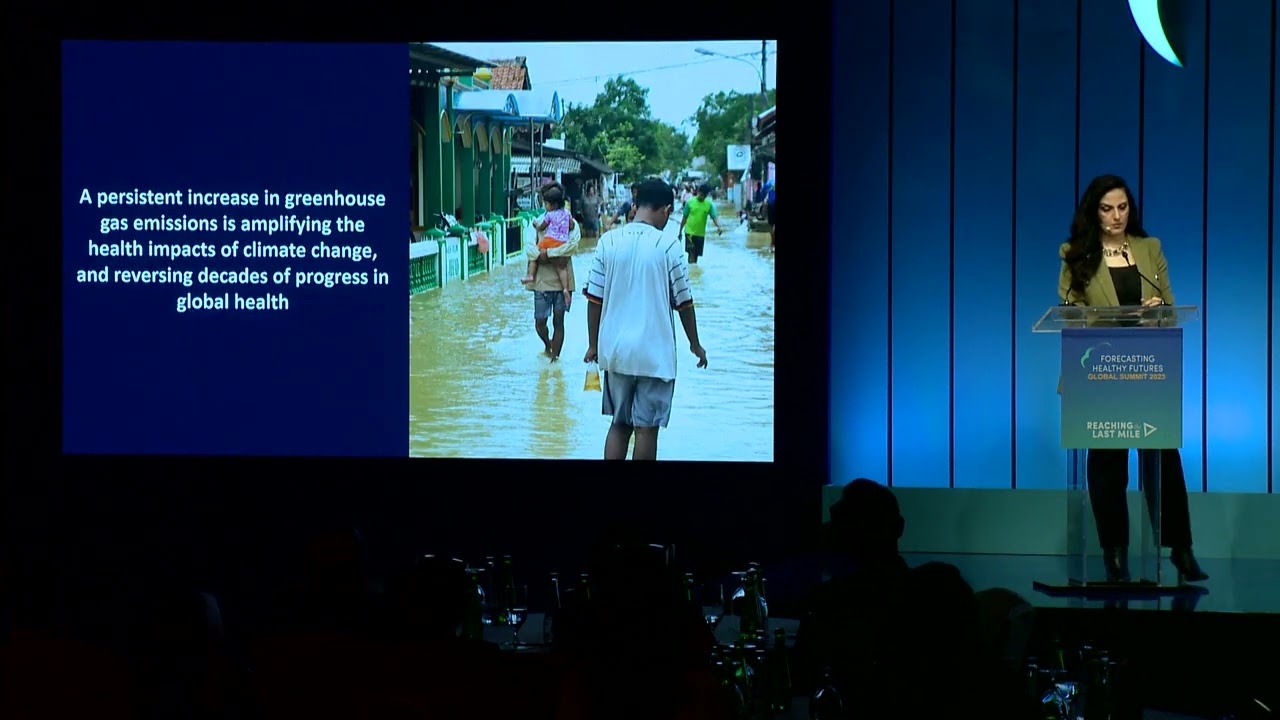
Monitoring the Health Impacts of Climate Change, & Health Opportunities of Ambitious Climate Action

Hear from The Lancet Countdown’s Executive Director, Marina Romanello on the latest report from the Lancet Countdown details the ways in which global heating is jeopardizing the lives and livelihoods of millions around the world, with more frequent and intense extreme weather events, higher risk of heat-related death, food insecurity and malnutrition, and infectious diseases that will continue to spread more rapidly and in new parts of the world. In a world facing compounding and simultaneous crises, it also identifies glimmers of hope. At this critical juncture, a health-centered response to the converging crisis, including a prompt transition away from fossil fuels, can today “still secure a future in which world populations can not only survive, but thrive”.
Video

Welcome Remarks at the Forecasting Healthy Futures Global Summit

Kelly Willis of Malaria No More & Tala Al Ramahi of Reaching the Last Mile,…

Welcome Remarks at the Forecasting Healthy Futures Global Summit

Kelly Willis of Malaria No More & Tala Al Ramahi of Reaching the Last Mile, welcome attendees of the Forecasting Healthy Futures Global Summit. #FHFSummit
Video

World Health Organization’s Director General, Tedros Adhanom Ghebreyesus addresses the FHF Summit

Tedros Adhanom Ghebreyesus, Director General of the World Health Organization, addresses the Forecasting Healthy Futures…

World Health Organization’s Director General, Tedros Adhanom Ghebreyesus addresses the FHF Summit

Tedros Adhanom Ghebreyesus, Director General of the World Health Organization, addresses the Forecasting Healthy Futures Global Summit for his remarks titled, “The Climate Crisis is a Health Crisis.”
Video

His Excellency Majid Al Suwaidi – Director General, COP28

HE. Majid Al Suwaidi, Director General for the upcoming COP28, addresses the Forecasting Healthy Futures…

His Excellency Majid Al Suwaidi – Director General, COP28

HE. Majid Al Suwaidi, Director General for the upcoming COP28, addresses the Forecasting Healthy Futures Summit for, “Inviting Solutions and Real Action” where he announces a health day for the upcoming COP28 conference hosted in the UAE.
Video

Solutions Spotlight: Changing Education Needs for a Climate-Resilient Health Workforce

Speaker: Dr. Kimberly Humphrey In January, Harvard Medical School announced its plans to integrate climate…

Solutions Spotlight: Changing Education Needs for a Climate-Resilient Health Workforce

Speaker: Dr. Kimberly Humphrey In January, Harvard Medical School announced its plans to integrate climate change into its curriculum. But an already overburdened global health workforce is largely unprepared for the massive shifts in burden of disease and novel health risks threatening the communities they serve. What can be done to empower health workers to understand current and future impacts, address them through preventative and clinical care, develop a stronger voice within the climate debate, and ultimately become part of the climate health solution?
Video

Solutions Spotlight: Innovative Incentives to Shape a Healthier Market for Essential Cooling

Heat could claim 1 million lives per year in India alone by the next century…

Solutions Spotlight: Innovative Incentives to Shape a Healthier Market for Essential Cooling

Heat could claim 1 million lives per year in India alone by the next century if unaddressed. One initiative hopes to shape markets and steer growing consumer demand toward highly efficient “clean” AC units, which could protect vulnerable populations while avoiding 60 gigatons of CO2 emissions by 2050. Featuring Dave Ripin, Chief Science Officer, Clinton Health Access Initiative
Video

Solutions Spotlight: Novel Technology to Improve Disease Control Cost-Effectiveness

IMACS’ Malaria Prediction and Planning Tool currently being evaluated in India and adapted for use…

Solutions Spotlight: Novel Technology to Improve Disease Control Cost-Effectiveness

IMACS’ Malaria Prediction and Planning Tool currently being evaluated in India and adapted for use in Indonesia uses climate predictions, epidemiological data, and program information to support local health systems’ optimized malaria control and elimination efforts. What role does intersectoral collaboration play in ensuring its success? What are the barriers to the uptake of this and similar tools in malaria-endemic countries? Featuring Dr. Kaushik Sarkar, Director, Institute for Malaria and Climate Solutions
Video

Solutions Spotlight: Public-Private Partnership – Data Philanthropy for Climate Preparedness

James Golden, Chief Data Officer, Rockefeller Foundation leads an informative session at the Forecasting Healthy…

Solutions Spotlight: Public-Private Partnership – Data Philanthropy for Climate Preparedness

James Golden, Chief Data Officer, Rockefeller Foundation leads an informative session at the Forecasting Healthy Future Global Summit. Accurate and accessible risk forecast systems require millions of data points from multiple sources, collaboratively build algorithms, and advanced computing power. A proposed global resource leverages modern logistics of data and democratization of AI tools, to predict exposure to systemic shocks, drive data-driven policies and response, and inform equitable investment in climate-resilient health systems.
Video

Solutions Spotlight: Two Sides of One Coin: Reimagining Healthcare Resilience and Net Zero Roadmaps

Jane Black and Gabrielle Sobel of Jacobs speak to the important topic of mitigating immediate…

Solutions Spotlight: Two Sides of One Coin: Reimagining Healthcare Resilience and Net Zero Roadmaps

Jane Black and Gabrielle Sobel of Jacobs speak to the important topic of mitigating immediate impacts of climate change and charting a long-term path to reduce carbon footprint are two critical pathways to reverse climate change and improve health resilience.
Video

Targeted Pre-Deployment of Prevention Interventions: Avoiding After-Effects of Extreme Weather

Many of the disease outbreaks most associated with flooding could be prevented with existing and…

Targeted Pre-Deployment of Prevention Interventions: Avoiding After-Effects of Extreme Weather

Many of the disease outbreaks most associated with flooding could be prevented with existing and emerging tools if they were deployed as part of a coordinated package to areas most at risk. Watch Paul Gunstensen, Global Safe Water Director of Evidence Action, Aysu Uygur, Strategy Officer of the Bill & Melinda Gates Foundation, and Emma Maynard, Research Manager for Infections & Climate of Wellcome Trust explore the questions: Which interventions would make the most effective combined preventative intervention? What kind of centralized resource could support local governments in designing and implementing it? Moderated by Colleen Connell, Managing Director of the Health Finance Coalition
Video

The Future Impacts of Climate Change on Human Health: Filling Knowledge Gaps

Experts predict a wide array of future threats and negative health impacts of climate change,…

The Future Impacts of Climate Change on Human Health: Filling Knowledge Gaps

Experts predict a wide array of future threats and negative health impacts of climate change, and their models differ drastically by disease, determinants, and economic impact. What further investment is needed to accurately describe the challenges, understand the scope and scale of climate-sensitive infectious disease, inform effective policy reform, and ensure equitable access to adaptation opportunities? Watch panelists Martin Muchangi, Director of Population Health & Environment at AMREF and Felipe J Cólon-González, Technology Lead for Data for Science and Health of the Wellcome Trust. Moderated by Malaria No More CEO, Martin Edlund.
Video

Climate Resilience in Public Health Systems: Essential Building Blocks

Resilient health systems are those that maintain continuous improvement of service and outcomes despite environmental…

Climate Resilience in Public Health Systems: Essential Building Blocks

Resilient health systems are those that maintain continuous improvement of service and outcomes despite environmental pressures, by anticipating threats and recovering from shocks resulting from climate change. Mazen Al-Malkawi, Montira Pngsiri, and Ahmed Elsayed moderated by Nino Kharaishvili to explore the question: What knowledge, intersectoral collaborations, and ongoing research capacity is required to effectively evaluate climate adaptation solutions while avoiding unintended consequences?
Video

On the Ground Innovations for Climate-Resilient Communities

Community engagement and action are essential ingredients of a climate-resilient health system and represent a…

On the Ground Innovations for Climate-Resilient Communities

Community engagement and action are essential ingredients of a climate-resilient health system and represent a set of opportunities and current innovations that are frequently overlooked by the formal public health sector. Bill Pan of Duke University moderates a panel discussion with Swati Mahajan of PATH South Asia and James Colburn of Clinton Health Access Initiative explore the question: How can environmental initiatives, economic activity, NGOs, and civil society contribute to climate-change mitigation and better-prepared communities?
Video

The Future Stewards: Youth Champions, Their Protection, and Empowerment

Youth advocates make up one of the most powerful forces for change in the global…

The Future Stewards: Youth Champions, Their Protection, and Empowerment

Youth advocates make up one of the most powerful forces for change in the global effort to stop climate change, and are increasingly active in championing issues specific to the health agenda. What interventions specifically address the unique health challenges facing youth and adolescents amid pressures of climate change? What opportunities exist to unlock their power and persuasion? Moderator: Sohini Chatterjee – Managing Director, Malaria No More Omnia El Omrani – COP27 Youth Envoy Isaiah Thomas – YOUNGO-Official Youth Constituency of UNFCCC Mohamed Eissa – Liaison Officer for Public Health Issues, IFMSA Deena Mariyam – YOUNGO-Official Youth Constituency of UNFCCC, Health Working Group Secretary
Video

Private Sector Catalysts: Strategic Investments to Unlock Innovation and Inform Climate Adaptation

Private foundations provide essential venture funding to test novel concepts. Leading healthcare corporations bring unique…

Private Sector Catalysts: Strategic Investments to Unlock Innovation and Inform Climate Adaptation

Private foundations provide essential venture funding to test novel concepts. Leading healthcare corporations bring unique value through their research and development programs, as well as solutions for equitable access to medicines. Combined, the private sector has an enormously important role to play in stimulating innovation and testing new approaches to climate solutions for health. How can the private sector’s investment be best leveraged to identify new solutions that will deliver at scale? What approaches will most effectively break down siloes and encourage aligned efforts and collaboration? Moderator: Buddy Shah – CEO, Clinton Health Access Initiative Uzma Sulaiman – Associate Director, Community Jameel Fiona Smith-Laittan – Vice President, Global Health, GSK Tala Al Ramahi – Director, Reaching the Last Mile
Video

Global Alignment & Effective Positioning: Resonating within the Climate Agenda

The global health community has an immediate opportunity to increase its voice in the fight…

Global Alignment & Effective Positioning: Resonating within the Climate Agenda

The global health community has an immediate opportunity to increase its voice in the fight against climate change, leveraging mounting evidence of growing mortality and morbidity rates as an incentive for greater government action to reduce carbon emissions, and communicating consensus opinion about the most important policy decisions and investment areas to protect human health from further harm. Watch Yacine Djibo, Founder & Executive Director of Speak Up Africa, Zied Mhirsi, Senior Director, Global Health Strategies, and Ramon San Pascual – Executive Director, Health Care Without Harm SE Asia explore the question of: What is the most effective way to put health at the center of the climate debate where it belongs? Moderated by Jeni Miller – Executive Director, Global Climate and Health Alliance
Video

Financing Climate Preparedness in the Health Sector: New Solutions to Resourcing

Malaria No More’s CEO Martin Edlund Moderates a panel with The Global Fund Executive Director…

Financing Climate Preparedness in the Health Sector: New Solutions to Resourcing

Malaria No More’s CEO Martin Edlund Moderates a panel with The Global Fund Executive Director Peter Sands and Found of World Bank Health, Climate & Environment Program, Tamer Rabie to explore the topic of how massive changes in the way climate adaptation funds are spent will be required to effectively build climate-resilient health systems, continue progress against preventable and communicable diseases, and take climate health solutions to a global scale. Listen as they answer questions: What investments can be leveraged to unlock new resources from other sectors and sources? Which approaches to blended financing will be most successful at mobilizing new sources of funding?
Video

Adaptation Funding for Health: Intersectoral partnership for national climate resilience

A persistent initiative in Malawi to secure adaptation funds for health system adaptation offers a…

Adaptation Funding for Health: Intersectoral partnership for national climate resilience

A persistent initiative in Malawi to secure adaptation funds for health system adaptation offers a multifaceted case study of what will be required to mobilize new resources to avoid the devastating impacts of climate change on health and well-being in low- and middle-income countries. Watch Hendricks Mgodie of the Malawi Ministry of Health and Burcu Munyas, Program Development and Quilty Director of Save the Children explore the questions: How can evidence of harm and risk be generated in the absence of established norms and reliable data sources? Which sectors need to be engaged to design interventions that meet the diverse needs of communities at risk, while avoiding unintended consequences? Moderated by GSK Global Health Communications Manager, Evie Gray.
Video

Climate Readiness, Resilience and Response: AI for Disease Prediction & Planning

Artificial intelligence is increasingly used to create efficiencies across health systems, in part through its…

Climate Readiness, Resilience and Response: AI for Disease Prediction & Planning

Artificial intelligence is increasingly used to create efficiencies across health systems, in part through its potential to make sense of interrelated climate trends and other variables for purposes of predicting risk and preventing disease. Join Hosni Ghedira, Hammam Riza, & Richard Maude moderated by Kelly Willis to explore the questions: What are some of the emerging data sources, which might improve the accuracy of AI-driven models? Can they help optimize prevention programs, allocate adaptation investment, and prevent the next pandemic?
Video

Climate Threats to Malaria and NTD Control & Elimination Programs: Progress at Risk

Changing rainfall patterns, rising temperatures, and extreme weather events are increasing the incidence and range…

Climate Threats to Malaria and NTD Control & Elimination Programs: Progress at Risk

Changing rainfall patterns, rising temperatures, and extreme weather events are increasing the incidence and range of vector-borne disease, and complicating efforts to combat and eliminate NTDs. What can be done to build donor coalitions, accelerate the development of new therapies, and identify new solutions in endemic country health systems? Join panelists Joelle Tanguy of DNDi, Do Trung Dung of the Veitnam National Institute of Malariology, and Hendricks Mgodie of the Malawi Ministry of Health moderated by Priy Kanayson of GLIDE.

2023 Agenda & Speakers

9:00 am

Welcome

  • Kelly Willis & Tala Al Ramahi – Co-Chairs, Forecasting Healthy Futures Global Summit


9:20 am

The Climate Crisis is a Health Crisis

  • Tedros Adhanom Ghebreyesus – Director General, WHO (via video)

We stand at an important inflection point at the convergence of: an unprecedented global commitment to prevent further destruction of our planet, a growing understanding of the potential catastrophe facing our human right to health, and the emergence of new knowledge and technologies to build equitable and resilient health systems.

9:25 am

The Lancet Countdown: Monitoring the Health Impacts of Climate Change, and the Health Opportunities of Ambitious Climate Action

  • Marina Romanello – Executive Director, Lancet Countdown for Climate and Health Action (via video)

The latest report from the Lancet Countdown details the ways in which global heating is jeopardizing the lives and livelihoods of millions around the world, with more frequent and intense extreme weather events, higher risk of heat-related death, food insecurity and malnutrition, and infectious diseases that will continue to spread more rapidly and in new parts of the world. In a world facing compounding and simultaneous crises, it also identifies glimmers of hope. At this critical juncture, a health-centered response to the converging crisis,  including a prompt transition away from fossil fuels, can today “still secure a future in which world populations can not only survive, but thrive”.


10:10 am

The Future Impacts of Climate Change on Human Health: Filling Knowledge Gaps

  • Martin Muchangi – Director, Population Health and Environment, AMREF
  • Felipe J Colón-González – Technology Lead, Data for Science and Health, Wellcome Trust​

Experts predict a wide array of future threats and negative health impacts of climate change, and their models differ drastically by disease, determinants, and economic impact. What further investment is needed to accurately describe the challenges, understand the scope and scale of climate-sensitive infectious disease, inform effective policy reform, and ensure equitable access to adaptation opportunities?

11:00 am

Dubai 2023: Inviting Solutions and Real Action 

  • His Excellency Majid Al Suwaidi – Director General, COP28


11:15 am

Break

11:30 am

Solutions Spotlight: Changing Education Needs for a Climate-Resilient Health Workforce

  • Kimberly Humphrey – Climate Change and Human Health Fellow, Harvard C-CHANGE

In January, Harvard Medical School announced its plans to integrate climate change into its curriculum. But an already overburdened global health workforce is largely unprepared for the massive shifts in burden of disease and novel health risks threatening the communities they serve. What can be done to empower health workers to understand current and future impacts, address them through preventative and clinical care, develop a stronger voice within the climate debate, and ultimately become part of the climate health solution?

11:45 am

Climate Resilience in Public Health Systems: Essential Building Blocks

  • Moderator: Nino Kharaishvili – Global Solutions Director, Jacobs
  • Mazen Al-Malkawi – Regional Advisor for Climate and Environment, World Health Organization
  • Montira Pongsiri – Senior Advisor, Climate and Health, Save the Children
  • Ahmed Elsayed – Executive Director, JPAL MENA
  • Resilient health systems are those that maintain continuous improvement of service and outcomes despite environmental pressures, by anticipating threats and recovering from shocks resulting from climate change. What knowledge, intersectoral collaborations, and ongoing research capacity is required to effectively evaluate climate adaptation solutions while avoiding unintended consequences?


12:45 pm

Solutions Spotlight: Two Sides of One Coin: Reimagining Healthcare Resilience and Net Zero Roadmaps

  • Jane Blake – Global Health Security Director, Jacobs
  • Gabrielle Sobel – Health Climate Response Program Manager, Jacobs

Mitigating immediate impacts of climate change and charting a long-term path to reduce carbon footprint are two critical pathways to reverse climate change and improve health resilience.

1:00 pm

Lunch

2:00 pm

Threats to Global Progress Against Preventable Disease

  • Trevor Mundel – President, Global Health, Bill & Melinda Gates Foundation (by video feed)


2:10 pm

Climate Threats to Malaria and NTD Control & Elimination Programs: Progress at Risk

  • Moderator: Priya Kanayson – Manager, Advocacy & Communications, Global Institute for Disease Elimination (GLIDE)
  • Corine Karema – Interim CEO, RBM Partnership to End Malaria
  • Joelle Tanguy – External Affairs Director, DNDi
  • Do Trung Dung – Head of Parasitology Department, Vietnam National Institute of Malariology, Parasitology, and Entomology (NIMPE)
  • Changing rainfall patterns, rising temperatures, and extreme weather events are increasing the incidence and range of vector-borne disease, and complicating efforts to combat and eliminate NTDs. What can be done to build donor coalitions, accelerate the development of new therapies, and identify new solutions in endemic country health systems?


3:15 pm

Solutions Spotlight: Public-Private Partnership – Data Philanthropy for Climate Preparedness

  • James Golden – Chief Data Officer, Rockefeller Foundation

Accurate and accessible risk forecast systems require millions of data points from multiple sources, collaboratively build algorithms, and advanced computing power. A proposed global resource leverages modern logistics of data and democratization of AI tools, to predict exposure to systemic shocks, drive data-driven policies and response, and inform equitable investment in climate-resilient health systems.

3:30 pm

Climate Readiness, Resilience and Response: AI for Disease Prediction & Planning​

  • Hosni Ghedira – Director, Mohamed bin Zayed University for Artificial Intelligence
  • Hammam Riza – President, Indonesia Agency for Assessment and Application of Technology
  • Richard Maude – Epidemiology Department Head, Mahidol-Oxford Tropical Medicine Research Unit

Artificial intelligence is increasingly used to create efficiencies across health systems, in part through its potential to make sense of interrelated climate trends and other variables for purposes of predicting risk and preventing disease. What are some of the emerging data sources, which might improve the accuracy of AI-driven models? Can they help optimize prevention programs, allocate adaptation investment, and prevent the next pandemic?

4:30 pm

Break

4:45 pm

On the Ground Innovations for Climate-Resilient Communities

  • Moderator: Bill Pan – Associate Professor, Global Environmental Health, Duke University
  • Swati Mahajan – Lead, Health Systems Strengthening, PATH South Asia
  • Peace Dziedzom Gbeckor-Kove – Principal Programme Officer, Ghana Environmental Protection Agency
  • James Colborn – Senior Advisor, Malaria, Clinton Health Access Initiative

Community engagement and action are essential ingredients of a climate-resilient health system and represent a set of opportunities and current innovations that are frequently overlooked by the formal public health sector. How can environmental initiatives, economic activity, NGOs, and civil society contribute to climate-change mitigation and better-prepared communities?

6:00 pm

Reception, Dinner & Networking